


I Lost 42 Pounds on a GLP-1. My Knees Didn't Get the Memo.
Everybody's sharing the Ozempic-and-knees headlines this year. A physical therapist at the Y read me the footnotes — and they're about what a joint eats, not what you weigh.
Let me say up front what this is and isn't. I'm not a doctor. I'm not going to tell you to start or stop anything your doctor put you on. And this isn't a miracle story.
I'm 64. I drove for UPS for thirty-one years. Up and down the truck step a couple of hundred times a day, boxes on the shoulder, knees doing the work. When I retired my blood sugar was where my doctor didn't want it, and about a year ago she put me on one of the GLP-1 injections.
It did what it says. Forty-two pounds in eleven months. New belt. New jeans, two sizes down.
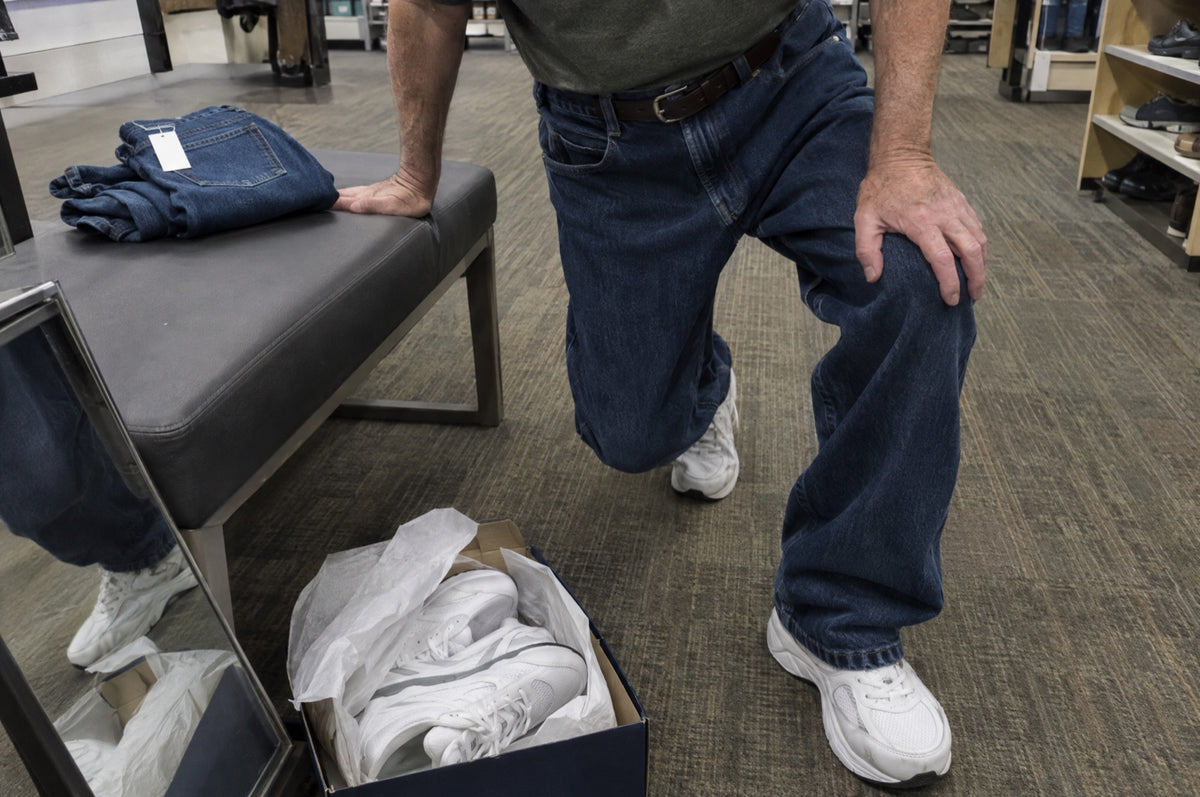
And here is the thing nobody warned me about: I still couldn't get down on one knee in the shoe store to try on the new sneakers I'd bought to celebrate.
Same knees. Same grind. Forty-two pounds lighter.
What finally made sense of it wasn't another headline. It was a physical therapist who runs the balance class at our Y, reading me the footnotes on the studies everyone's been posting — in about five minutes, in the parking lot, not selling a thing.
Let me start at the end: I got down on one knee in a shoe store.
I'll do the studies in a minute, because the studies are the reason I believed any of this. But you didn't come here for footnotes. You came here because something hurts and you thought losing the weight would fix it.
So: ten weeks after the parking lot. I take the truck step — it's a pickup now, not a UPS van, but the step is the same height — without the hand on the door frame. I did the whole of my grandson's zoo trip in one go, no bench. And the thing I actually wanted: I knelt down on the floor of a shoe store, tied a lace, and stood back up without making the noise.
The scale didn't move much in those ten weeks. I'd already lost the weight. What changed was what the joint was getting, not what it was carrying.
"Ozempic could fix your knees." Here's what the studies actually found.
You've probably seen the graphics. I'd seen them all before my doctor ever mentioned the injection, and honestly they were half the reason I said yes.
They come from three real pieces of research, and I want to be fair to them because they're good work.
2024, New England Journal of Medicine. The STEP 9 trial. 407 adults with obesity and knee osteoarthritis, 68 weeks. The semaglutide group lost 13.7% of their body weight against 3.2% on placebo, and their knee pain scores dropped further — a 41.7-point improvement against 27.5.
March 2026, Cell Metabolism. A Chinese Academy of Sciences team ran the drug in mice with osteoarthritis — and here's the clever bit — they diet-controlled the untreated mice so both groups lost the same weight. Only the treated knees showed protected cartilage. A small human pilot, 20 people over 24 weeks, showed thicker cartilage on MRI.
June 2026, Regional Anesthesia & Pain Medicine. Tens of thousands of knee-arthritis patients in a health database. The ones on a GLP-1 for three years had fewer knee replacements over eight years — about 5% fewer.
All true. All published. I'm not here to argue with any of it.
Twenty people in the human pilot. Mice for the cartilage pictures. "About 5% fewer" knee replacements, over eight years, on a drug you take indefinitely. And every one of the researchers, when asked, said the same thing: weight loss is still the most effective thing we know of for knee arthritis, and the rest is early.
None of that is a reason not to be on the medication if your doctor wants you on it. It's a reason not to expect it to do a job it was never tested for.
The weight came off. The ache stayed. There's a boring reason for that.
The physical therapist asked me two questions in that parking lot. The first one was: "How much of the forty-two pounds was muscle?"
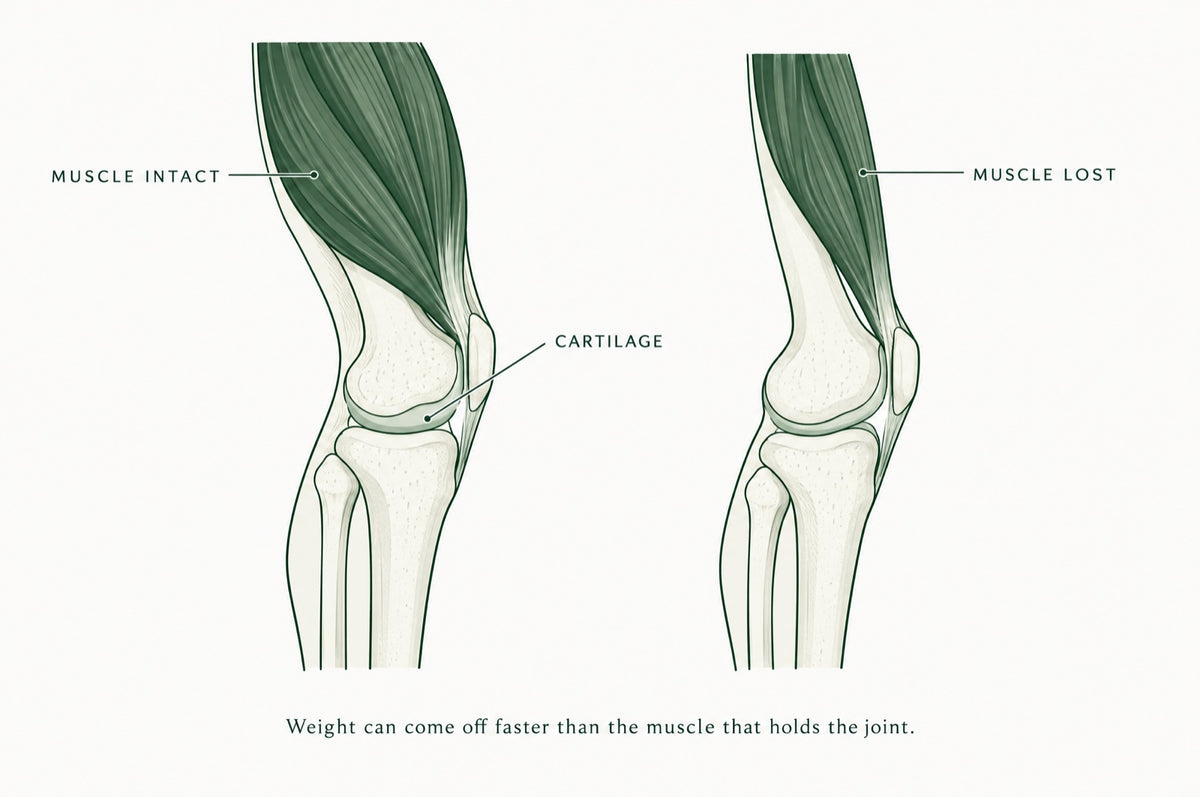
I didn't know. It turns out a lot of people don't. The injections take appetite away, and when you eat less for a year without lifting anything, the body doesn't only spend fat. It spends muscle too — and the muscle around a knee is what holds the joint lined up under load.
She put it plainly: every pound you carry puts about four pounds through the knee on a step. So forty-two pounds off is a hundred and sixty-eight pounds less per step. That's real, and it's why the stairs felt a bit better. But if the thigh that steadies the knee got smaller at the same time, the joint is lighter and less supported. Which is a strange place to be, and exactly where I was.
Orthopedic clinics are now saying this out loud: the two things they watch in patients on these drugs are muscle loss and bone density. Neither is on the graphic.
And even that, she said, wasn't the real footnote. The real one was about what a knee actually eats.
The mice lost the same weight. Only the treated knees improved. Ask why.
Go back to that Cell Metabolism study, because the interesting part isn't the headline. It's the design.
The researchers made the untreated mice lose exactly as much weight as the treated ones. If the knee benefit were just about weight, both groups would look the same. They didn't. So the team went looking for what else the drug was doing to the joint — and what they found was about the cartilage cells' fuel supply. Stressed cartilage cells run on an inefficient energy pathway; the drug seemed to switch them back to a healthier one.
Read that as a layman and one question jumps out: if cartilage has a fuel supply that can be starved or fed — how does it get fed in the first place?
That's the question I'd never asked in nine years of taking glucosamine. Here's the answer she gave me, and it's first-year anatomy.
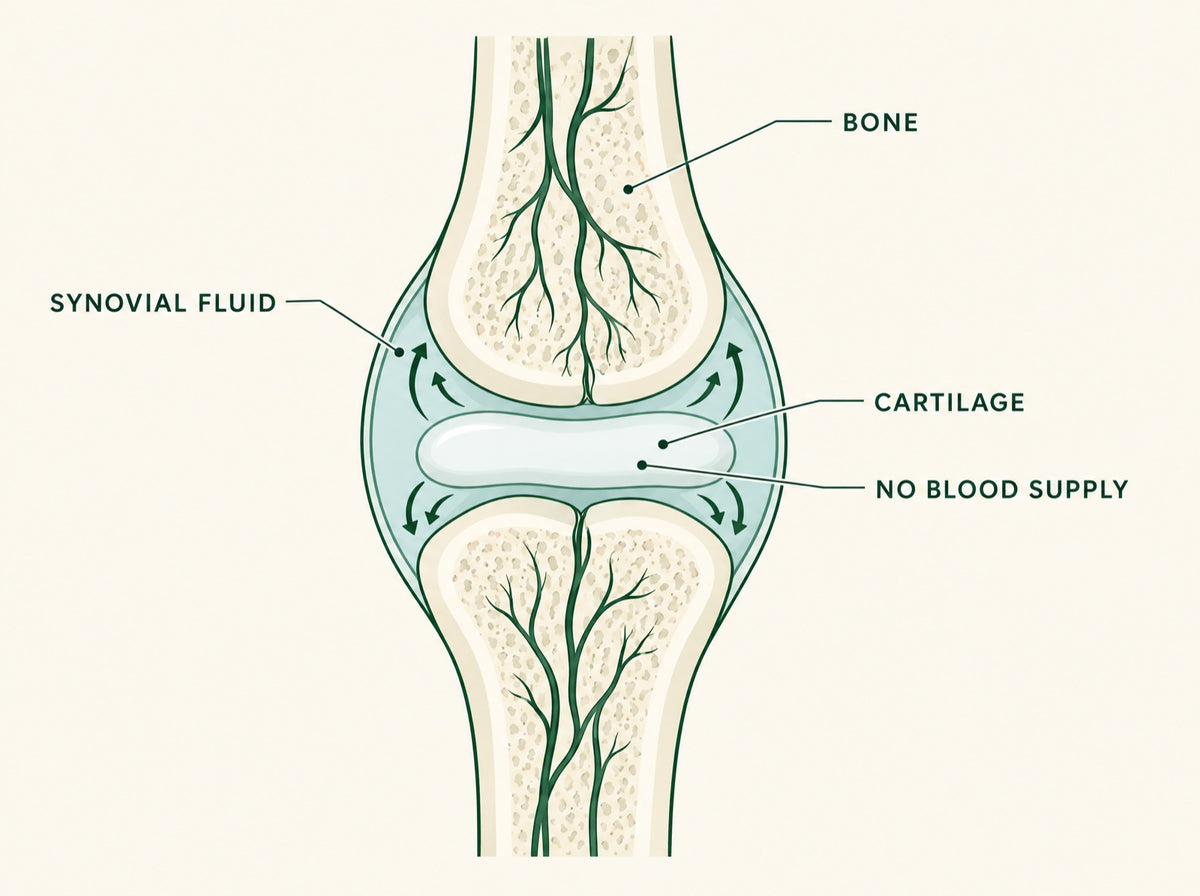
Cartilage has no blood supply. None. It can't pull nutrients out of your bloodstream the way muscle or skin does, because there's no blood going to it. It's a sealed cushion between two bones, and it feeds like a sponge — it drinks the fluid inside the joint, and every step squeezes old fluid out and draws fresh fluid in.
That fluid is the only way in. Not the scale. Not the injection. The fluid.
Nine years of glucosamine that never made the jump.
Her second question was the one I've thought about every day since:
"How long have you been taking joint pills that never leave your bloodstream?"
Nine years. Glucosamine first, then the turmeric one because a guy at the depot swore by it. Every morning. Never felt a thing.
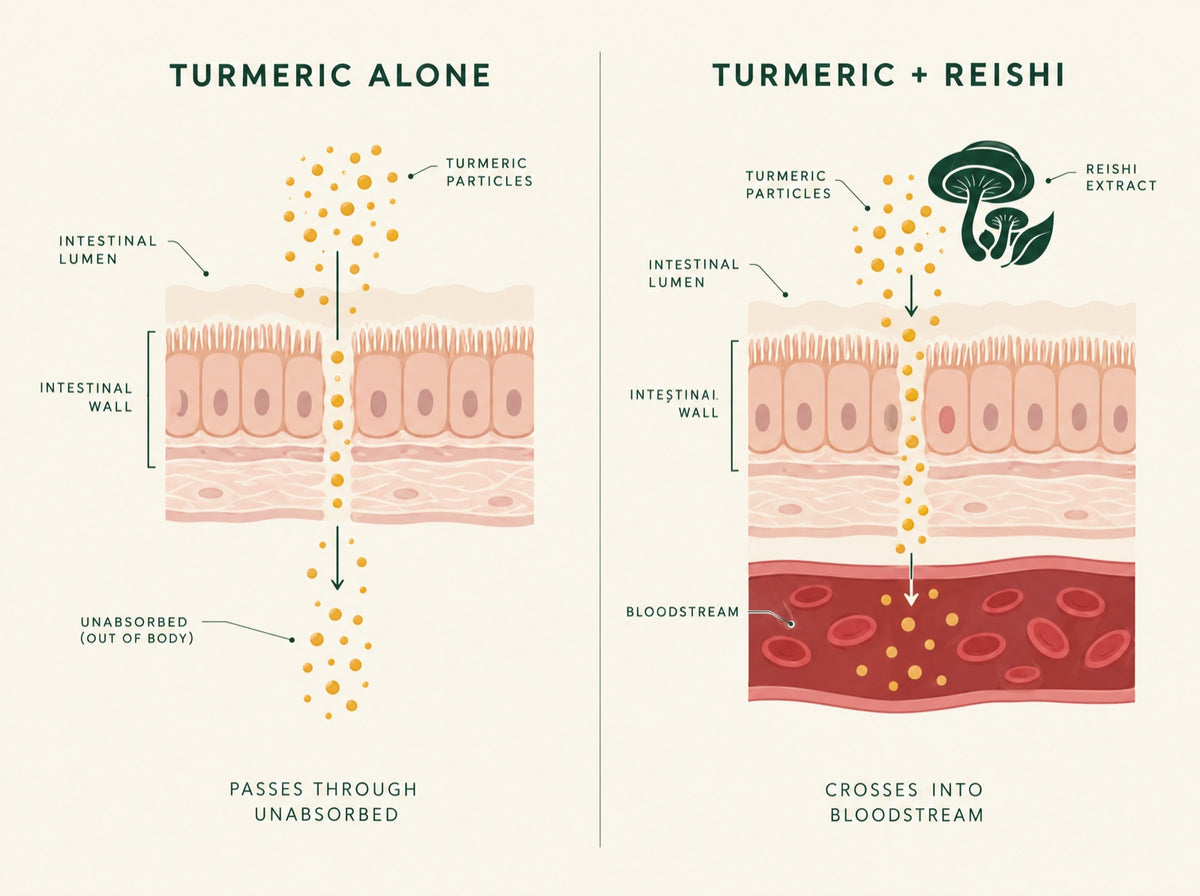
Two walls, she said. First, most of what's in those bottles never gets absorbed at all — turmeric especially; on its own the body takes in almost none of it. Second, whatever does get absorbed lands in your blood, and cartilage doesn't drink from your blood. It has to get out again, into the joint fluid. Most of it never does. It circulates, and it leaves.
"You didn't fail the supplement. The supplement never made the jump."
Nine years of pills arriving in the wrong room. Then a year of losing weight off a joint that was still being starved. The scale changed. The room the knee eats from didn't.
The scale changed. The room the knee eats from didn't.
I want to be completely straight, because the internet is not. What I take now is a food supplement. It is not semaglutide, it does none of what the drug did in those studies, and nothing about it is a reason to start or stop a medication your doctor prescribed. If you're on a GLP-1, stay on it and talk to your doctor about protein and strength work — that's the muscle footnote, and it's theirs to handle.
What I changed is smaller and, for my knees, turned out to matter more: I stopped swallowing things that never reached the joint, and started taking something built to.
Most of it doesn't even get into you
Turmeric is the comfort compound in nearly every joint formula on the shelf. On its own your body barely absorbs it — most passes straight through, unused. Nine years of my mornings, in other words.
Flexa pairs turmeric with Reishi, a functional mushroom shown to help the body take in up to 99× more of it than standard turmeric.* Same ingredient. Finally in a form that gets past the first wall.
And what does get in has to make the jump
Clearing the gut is not the same as reaching the joint. Cartilage sits downstream of the joint fluid, not of a vein.
That's why dose and molecule size matter, and why a few hundred milligrams pressed into a hard capsule with no absorption partner was never going to reach the surface that's actually worn — however much weight you take off it.
Into the joint fluid, at the wear surface, pumped deeper with every step. That's the whole job.
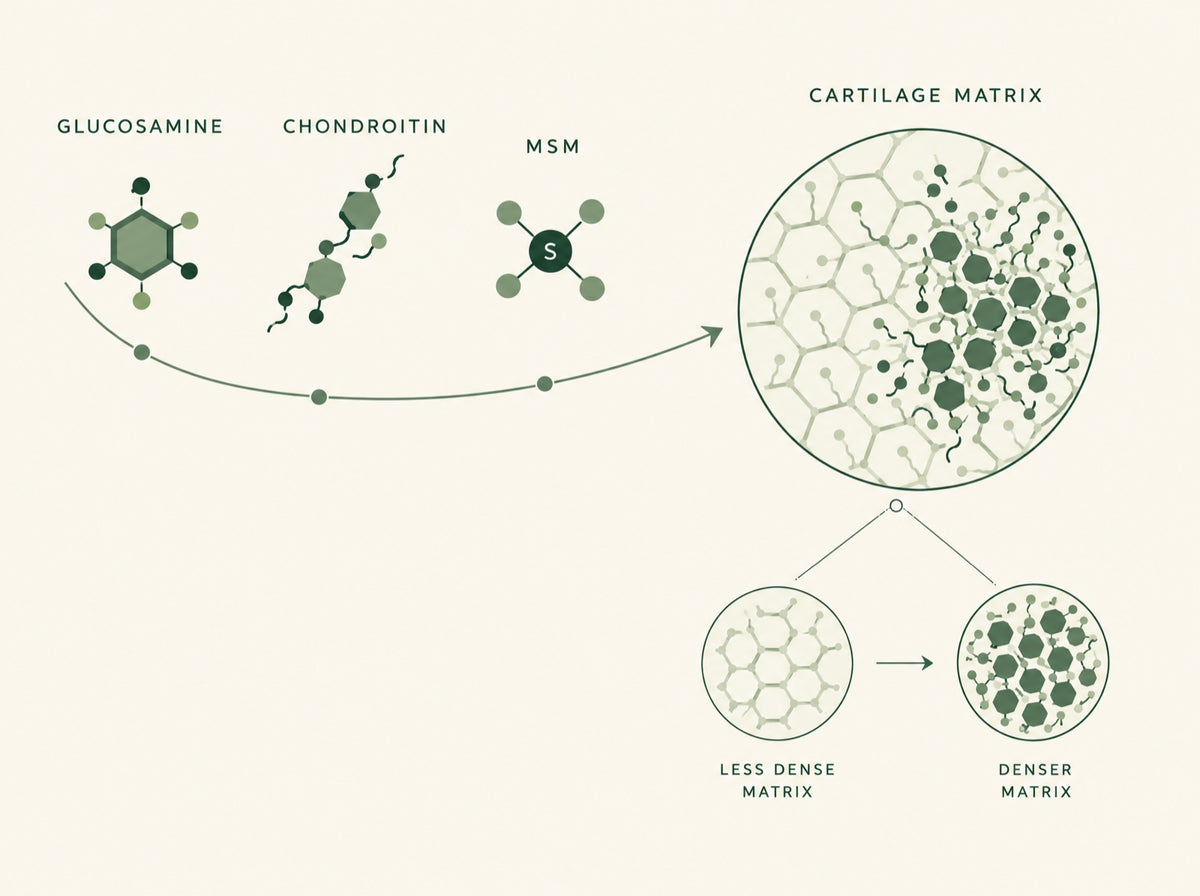
What's actually in it, and why each thing is there
I checked every line against the trials before I ordered. Thirty-one years of delivering other people's packages makes you read labels.
| Ingredient | Per daily serving | Why it's in there |
|---|---|---|
| Glucosamine | 1,500 mg | A building block of cartilage. This is the dose used in the NIH-funded GAIT trial — not the token amount on my old bottle. |
| Chondroitin | 800 mg | Paired with glucosamine in the trials; helps cartilage hold water, which is what makes a cushion a cushion. |
| MSM | 1,000 mg | A sulfur compound with its own placebo-controlled knee trials. |
| Turmeric | 200 mg | The comfort compound — reviewed across 16 trials and 1,810 adults. |
| Reishi | included | The absorption partner. This is the one most formulas leave out, and the reason the rest can get in at all. |
| Vitamin D3 | included | Contributes to normal muscle function and the maintenance of normal bones — the two things the clinics now watch on GLP-1s. |
| Calcium | included | Contributes to the maintenance of normal bones. |
They ran it against a prescription drug. It held.
This is the part that ended my skepticism, and it's why I'm comfortable writing any of this down.
Glucosamine and chondroitin were tested in GAIT — NIH-funded, 1,583 people, at 1,500mg of glucosamine a day. The exact dose in Flexa.
Then MOVES: 606 people, the same combination, head to head against celecoxib, a prescription anti-inflammatory, over six months. Comparable results.
That's not a wellness claim. That's a supplement combination run against a prescription drug in a randomized trial and not losing.
The studies referenced above
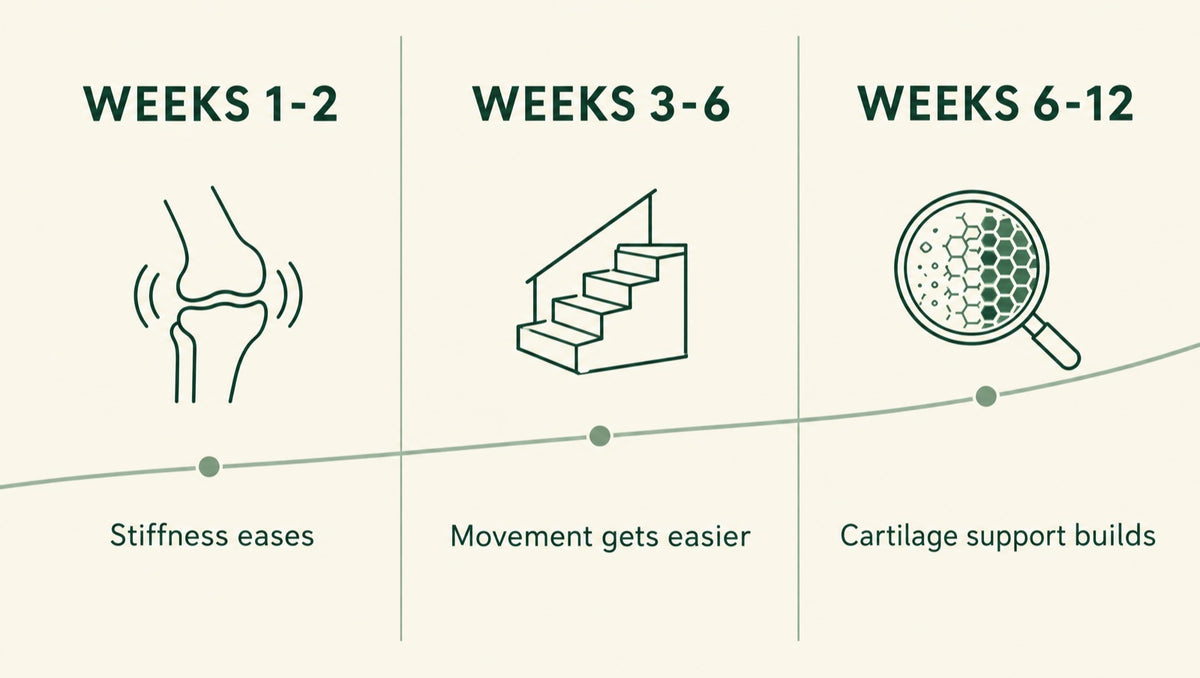
What actually happened, week by week
Nobody gives you the timeline, so you quit in week three thinking it failed. Here's mine, honestly, starting from the parking lot.
Weeks 1–2. Nothing I'd swear to. Two green-apple gummies with coffee. The scale, for the record, didn't move.
Weeks 3–5. The truck step without the hand on the door frame. I noticed on a Tuesday and didn't tell anyone in case it went away.
Weeks 6–10. The stretch that matters. Raw material, delivered daily, doing quiet work. I also started the strength class at the Y, because of footnote one.
Week 10. The shoe store. One knee, lace tied, back up. No noise.
Give it the twelve weeks. Judging it at three is how I wasted nine years.
Real users, real results
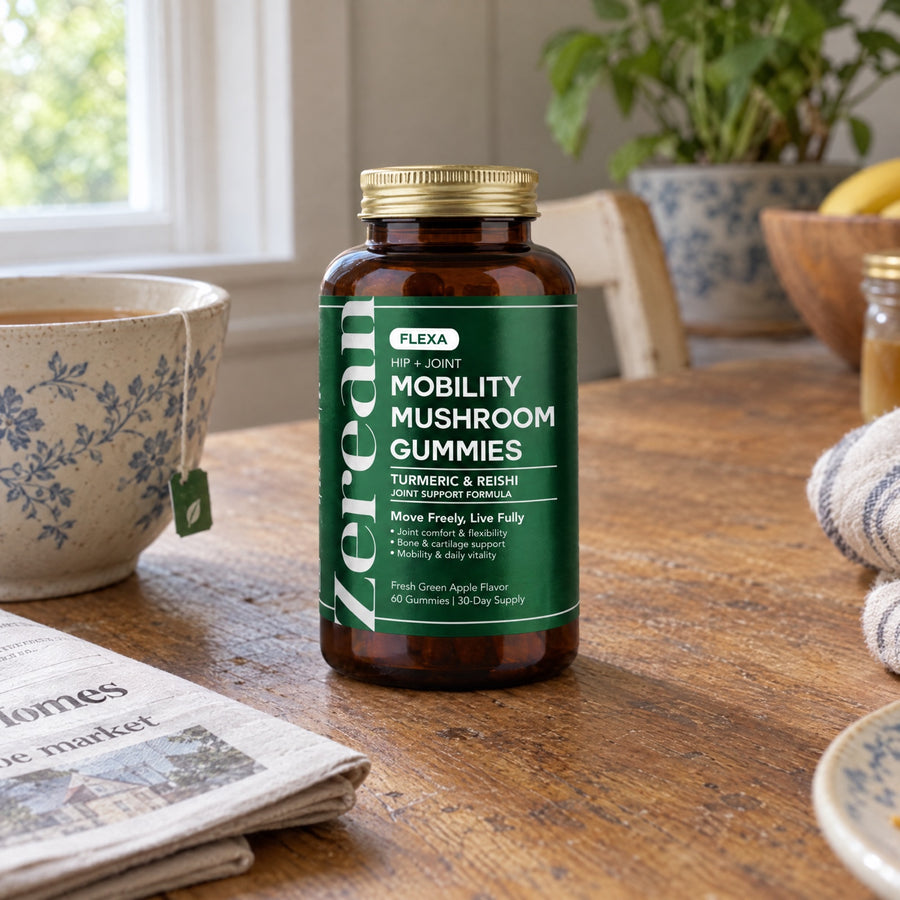
Your first bottle, 46% off
First order only, one per customer. Free shipping on orders over $80. Regular price $64.99.
4.7 on Trustpilot · GMP-Certified · Third-Party Tested
Judge it at ninety days. Not at three weeks.
You can't feel cartilage being fed in an afternoon. Glucosamine, chondroitin and MSM are raw material, not painkillers — delivered daily, doing quiet work over weeks. Most people who say a joint supplement "did nothing" stopped in week three, before anything had a chance to happen.
So don't judge this bottle overnight. Two gummies with breakfast, every day, and look back at the twelve-week mark: the stairs, the truck step, getting up off the floor. That's the honest test, and it's the only one we'd ask you to run.
Questions people ask before their first bottle
Flexa is a food supplement — glucosamine, chondroitin, MSM, turmeric, mushrooms, vitamin D3 and calcium. Most people take it with breakfast. But you're on a prescription, so ask your doctor or pharmacist before adding anything, and don't change your medication because of an article. We'd rather you asked.
No. Those studies were of a prescription drug, and the cartilage findings are early — mice and a 20-person pilot. Flexa supplies the raw material cartilage is built from, in a form built to reach the joint fluid. That's a different and much smaller claim, and the only one we make.
Almost certainly your old bottle had no absorption partner and no way into the joint fluid — so the ingredients were fine and they never arrived. That's the whole reason Reishi is in this formula.
It isn't a painkiller and we won't pretend otherwise. It supplies the material cartilage is built from. That's a slower, different thing than muting a signal.
No. What you see is what you're charged, once. If you'd like it sent automatically you can choose that at checkout, and change or stop it whenever you like.