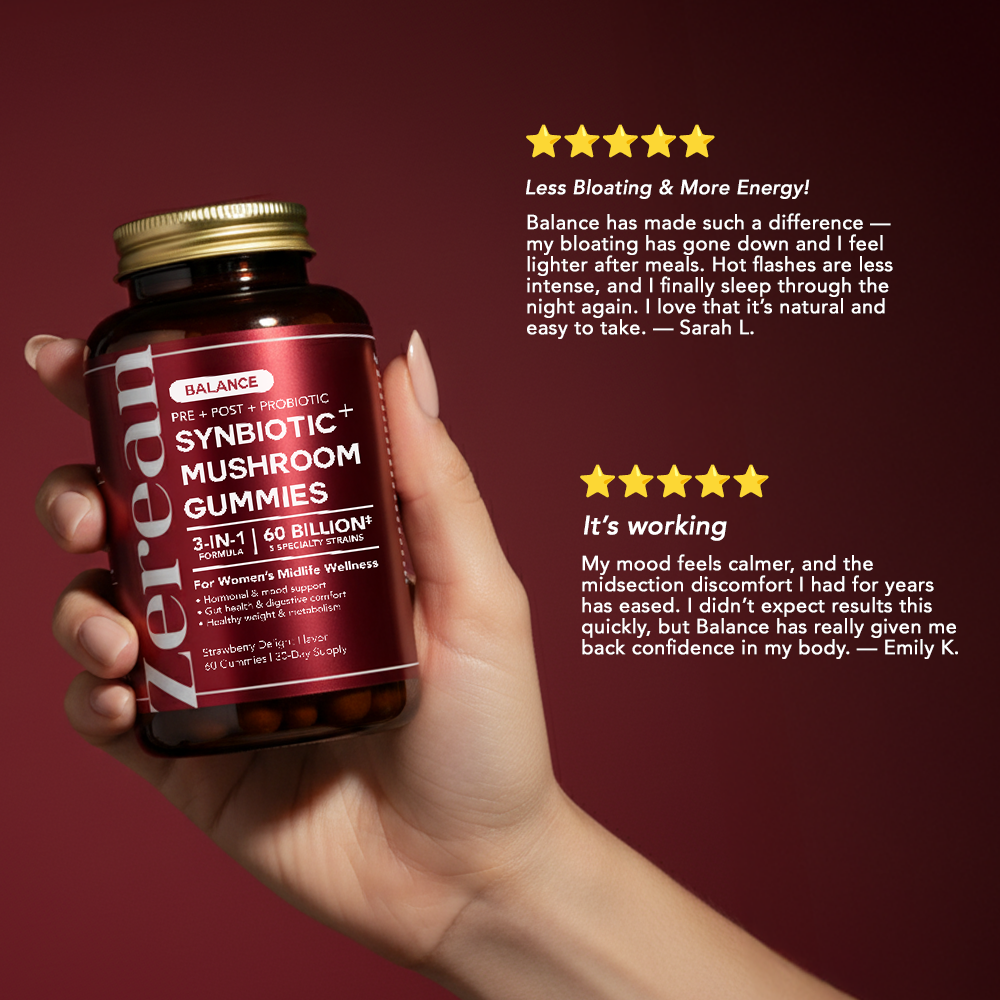
Hot flashes, night sweats, brain fog, mood swings — all trace back to shifting estrogen and the gut that helps regulate it. Balance works that root: women’s botanicals, a 60-billion synbiotic, and Lion’s Mane.
Hot flashes, fewer & milder.
That sudden flush in a meeting, the fan on at your desk. Red clover isoflavones — the plant compound most studied in menopausal women for hot flushes — work with your own estrogen signaling to take the heat down. Most women feel the shift by weeks 4–8.
Nights you sleep through.
Waking at 3am soaked, kicking off the covers. As the estrobolome helps steady estrogen and your gut settles, night sweats ease and deep sleep returns — so you wake rested, not wrung out.
The brain fog lifts.
Losing words mid-sentence, blanking on a name you’ve known for years. Lion’s Mane works along the gut-brain axis — studied for memory and clarity — while B6 supports focus. The fog thins and the words come back.
Steadier mood, real energy.
The short fuse, the afternoon wall. Chasteberry and white peony are traditional women’s botanicals for even mood, and B6 supports natural energy — so you feel like yourself again, all day, caffeine-free.
That sudden flush in a meeting, the fan on at your desk. Red clover isoflavones — the plant compound most studied in menopausal women for hot flushes — work with your own estrogen signaling to take the heat down. Most women feel the shift by weeks 4–8.
Waking at 3am soaked, kicking off the covers. As the estrobolome helps steady estrogen and your gut settles, night sweats ease and deep sleep returns — so you wake rested, not wrung out.
Losing words mid-sentence, blanking on a name you’ve known for years. Lion’s Mane works along the gut-brain axis — studied for memory and clarity — while B6 supports focus. The fog thins and the words come back.
The short fuse, the afternoon wall. Chasteberry and white peony are traditional women’s botanicals for even mood, and B6 supports natural energy — so you feel like yourself again, all day, caffeine-free.
Ingredients studied at leading institutions
Inside the formula
Eight ingredients. Every one earns its place.
Three botanicals women have trusted through the change for centuries, four science-led actives, and a synbiotic system that feeds both the estrobolome and the gut-brain axis.
The functional mushroom in the formula — traditionally used to support mental clarity and focus, working along the gut-brain axis.
A plant source of isoflavones — the botanical women reach for most during the menopause transition.
Used for centuries to support hormonal rhythm and steady, even mood.
A foundational botanical in traditional women's wellness, valued for its long heritage.
Lactobacillus and Bifidobacterium strains that support gut comfort and the estrobolome — the gut bacteria involved in estrogen metabolism.
Fuel for your good bacteria — the synbiotic partner that makes the probiotics work harder.
Soluble plant fiber — the third pillar of gut support, alongside the probiotic and prebiotic.
Essential cofactor — supports normal energy metabolism and nervous-system function.
Digestion isn't the whole story.
The only menopause gummy that works both pathways.
A true 60-billion synbiotic, women's botanicals, and Lion's Mane in one strawberry gummy. Every other option covers one pathway and drops the other.
Feature
Zerean Balance
Menopause botanical blend
Clinical synbiotic capsule
Focus shot / drink
Made for women
True 60B, 7-strain synbiotic (pre + pro)
Lion's Mane for focus & energy (gut-brain axis)
Caffeine-free — no crash
One daily gummy (no capsules, powders, shots)
THE BALANCE TIMELINE
Built to be felt, week by week.
Menopause symptoms ease as your gut and hormones re-steady. Most women feel the biggest shift between weeks 3 and 8 — here’s the path.
Week 1
Settling in.
Two strawberry gummies a day — that’s the whole routine. Behind the scenes, the synbiotic starts seeding your gut, the foundation your hormones rely on.
Weeks 2–4
The first symptoms ease.
Less bloating, steadier energy, and the first calmer nights — as your gut settles and estrogen signaling steadies. Small but real.
Weeks 6–8
It all clicks.
Hot flashes fewer and milder, night sweats easing, the brain fog thinning and words coming faster — as the estrobolome and gut-brain axis find their rhythm. Consistency compounds it.
The things real women ask before they buy.
Your Questions, Answered
check_box
What will I actually feel, and when?
Gut settles first — less bloat, calmer nights (weeks 1–2). Then hot flashes ease, sleep deepens, and brain fog lifts (weeks 3–8). It’s relief that builds, not a quick hit.
check_box
Will it help my hot flashes and night sweats?
That’s what it’s built for. Red clover isoflavones are the most-studied plant compound for menopausal hot flushes, and steadier estrogen — via the estrobolome — helps calm the night sweats that wreck your sleep. Give it 4–8 weeks of daily use.
check_box
What are the estrobolome and gut-brain axis?
Two jobs your gut bacteria do: the estrobolome recycles and regulates your estrogen — the system menopause puts under pressure; the gut-brain axis carries focus + energy signals to your brain. Balance feeds both — that's why it's formulated for women in midlife.
check_box
How's it different from my regular probiotic?
A regular probiotic helps digestion. Balance helps digestion **plus** your focus, energy, and hormonal steadiness — because it feeds both gut systems, not just one.
check_box
Is it hormone-free? Vegan? Non-GMO?
Yes to all — no hormones, no synthetic estrogens (Balance is not HRT); vegan, non-GMO, low-sugar, GMP.
check_box
I'm perimenopausal — is this for me?
Yes. Perimenopause is when the estrobolome and gut-brain axis first start shifting — many women start Balance at the first signs: fog, disrupted sleep, on-edge days.
check_box
How do I take it?
2 gummies daily, with or without food. Strawberry.
check_box
Side effects / on medication?
Well tolerated; a short adjustment period is normal as your gut adapts. Check with your provider if pregnant, nursing, or on medication.
Noté que muchos problemas intestinales mejoraron.
Llevo un mes con este producto y me gustó mucho, desde su sabor hasta sus efectos. No es milagroso, va corrigiendo poco a poco el desastre de años. Tarda un poco en llegar pero sí llega.
M
Maria
Llegó en buen estado y bien empacado ahora a probarlo y ya les contaré